
Talc-Free Ayurvedic Baby Powder Making as a Doctor
March 12, 2026
Are you a BAMS-qualified Ayurvedic doctor with years of clinical training — and still facing empty consultation slots week after week? Are large wellness brands gaining the patients who should genuinely be walking into your clinic? And consider this: what if the missing piece isn’t your clinical knowledge at all, but how you bring that knowledge to market?
These are uncomfortable but important questions for thousands of talented practitioners across India. Exceptional skills in classical Panchakarma, herbal formulation, or Nadi Pariksha don’t automatically create consistent patient flow or stable income. Without a structured approach to reaching and retaining patients — and monetizing expertise beyond consultation fees — growth stays frustratingly out of reach.
Here’s the context that matters: India’s Ayurveda market is projected to reach ₹71,000 crore by 2028, growing at a CAGR of 15–16%. Patients are actively searching for authentic Ayurvedic practitioners and natural wellness products. Those who will capture this demand are practitioners with a clear, actionable approach to market entry — a shift already documented in the 2026 State of Agentic AI in B2B GTM study, which highlights how structured GTM frameworks are reshaping how service-based professionals reach their markets. This guide is built specifically for Ayurvedic professionals — BAMS doctors, vaidyas, wellness entrepreneurs, and serious students. It walks through using a GTM tool to grow clinic revenue in practical steps, from audience clarity and pricing to launching proprietary products. By the end, you’ll have a solid foundation for turning your clinical expertise into a scalable, multi-revenue-stream practice.
What Is a GTM Tool and Why Your Ayurvedic Clinic Needs One in 2026

A GTM — or Go-To-Market — strategy is a structured action plan that answers four defining questions for your practice:
Who are your ideal patients?
What value do you offer that others don’t?
How do you reach them effectively?
How do you convert initial interest into lasting clinic revenue?
When people talk about GTM tools for Ayurvedic doctors, they’re referring to both strategic frameworks — audience profiling, value proposition design, pricing models — and practical digital platforms like Google Business Profile, SEO tools, and WhatsApp Business that put those frameworks into action.
A common assumption is that GTM thinking belongs only to large pharmaceutical companies or corporate hospital chains. That assumption costs individual practitioners real money. Whether you run a solo practice in a semi-urban area or a growing multi-therapy clinic in a metro city, GTM tools for clinics and hospitals are just as relevant — and far more accessible — than most practitioners realize.
Without a deliberate market strategy, even the most clinically excellent Ayurvedic practice runs into the same recurring problems: inconsistent patient flow, underpriced consultations, and income tied entirely to working hours with no product revenue. Your clinical knowledge stays confined to the consultation room, while competitors — including non-clinical wellness brands — show up more visibly where patients are looking.
“Strategy without execution is a daydream. Execution without strategy is a nightmare.” — Adapted business wisdom widely cited in marketing and operations planning.
The six pillars of a clinic-focused GTM framework are:
Audience definition
Value proposition
Channel selection
Pricing strategy
Product launch planning
Performance tracking
Understanding and applying these pillars is what separates a clinic that plateaus year after year from one that grows into a recognized brand. India’s booming wellness market rewards practitioners who show up with clarity and consistency — and those applying GTM tools in the healthcare industry are already seeing the difference.
How to Define Your Target Patient and Build a Winning Value Proposition

Every effective GTM strategy begins with one foundational question: who are you actually serving? Ayurvedic clinics work with genuinely different patient groups — each with distinct concerns, decision-making triggers, and spending behavior — and trying to reach everyone at once produces messaging that resonates with almost no one.
The most common patient segments for Ayurvedic practitioners include:
Chronic disease patients managing PCOD, arthritis, psoriasis, or digestive disorders
Preventive wellness seekers who are health-conscious and willing to invest in personalized care
Cosmetic and beauty consumers drawn to natural, plant-based skincare
Postpartum patients seeking traditional recovery support
Urban professionals dealing with stress and lifestyle-related concerns
Narrowing your focus to one or two primary segments makes every downstream marketing decision — what to post, which platforms to use, how to price — significantly more effective.
Building a buyer persona makes this concrete. Consider the difference between a BAMS practitioner in Bengaluru serving working women with hormonal concerns and a rural vaidya supporting agricultural communities in Maharashtra. Same profession, but entirely different communication approaches, product types, and price sensitivities. Documenting your primary patient segment clearly — before making any marketing or pricing decision — is one of the highest-value actions you can take when using a GTM tool to grow clinic revenue.
Once your segment is defined, your value proposition needs to be equally clear. What genuinely sets your clinic apart? If you hold a BAMS degree with specialized training in classical cosmeceutical formulations, that’s a real differentiator. A strong value proposition might read:
“Classical Ayurvedic formulations developed by a qualified vaidya, standardized for modern therapeutic use — trusted by patients, backed by tradition.”
This is precisely the kind of positioning that Sampurnam Ayurveda Company’s formulation and brand-building workshops help practitioners develop — combining clinical authenticity with a marketable product identity that patients trust and competitors can’t easily replicate.
GTM Revenue Strategies — Building Multiple Income Streams for Your Clinic

Depending solely on consultation fees is the most common revenue risk in Ayurvedic practice. Your earning potential is capped by how many hours you can work, and seasonal fluctuations in patient volume make monthly income unpredictable. A multi-stream model changes this entirely — and it’s one of the core benefits of using a GTM tool to grow clinic revenue in a structured way.
A well-designed revenue model for Ayurvedic clinics typically layers income sources like this:
Base layer — Consultation services: Standard OPD visits, tele-consultations that extend your geographic reach, and premium long-duration consultations for complex chronic cases
Mid layer — Panchakarma and therapy packages: Bundled 7-day, 14-day, or 21-day structured programs that command significantly higher per-patient revenue while improving clinical outcomes through continuity of care
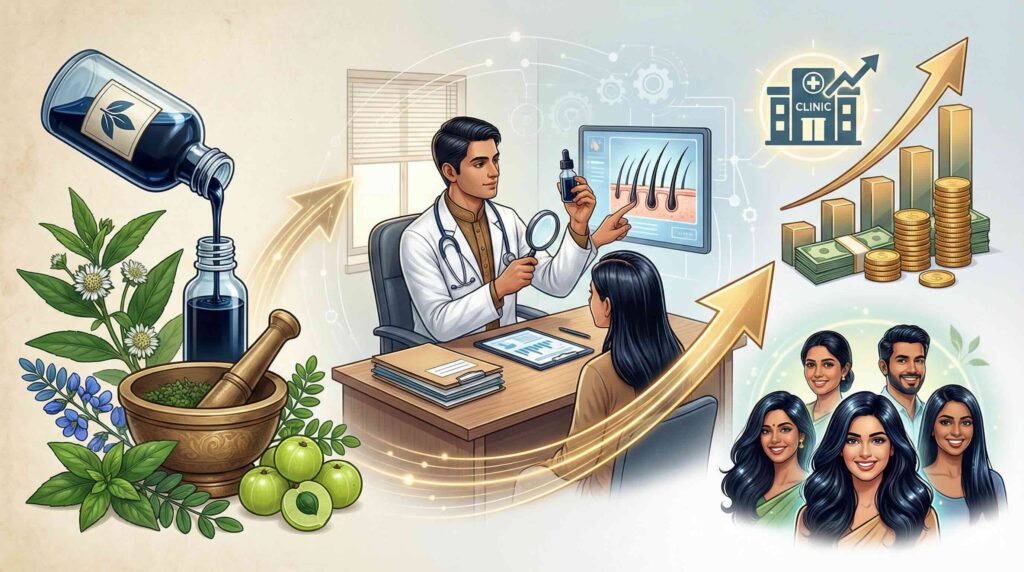
Top layer — Proprietary product line: Clinic-branded herbal formulations — face oils, hair oils, digestive supplements, women’s wellness preparations — that generate recurring revenue independent of your schedule
Sampurnam Ayurveda Company’s hands-on masterclasses in formulations like Kumkumadi Tailam, Neelibhringadi Tailam, and Shatdhout Ghrit give practitioners the formulation science, standardization skills, and business frameworks needed to launch their own branded products — even without a manufacturing unit. Branded Ayurvedic products sold directly through a clinic or owned digital channel typically yield 40–60% gross margins, a margin profile that consultation-only models simply can’t match.
Training and workshop revenue is another stream many practitioners overlook. Teaching herbal product making or cosmeceutical formulation to students and fellow practitioners creates meaningful income while building your professional authority in the field. Additional revenue channels worth considering:
Online subscription-based wellness plans and diet guidance
Digital Panchakarma preparation kits
Retail partnerships with platforms like Amazon or 1mg
On pricing: value-based pricing, anchored to patient outcomes rather than just time spent, reflects the genuine value an experienced practitioner delivers. Bundle pricing — combining a consultation with prescribed take-home formulations in a “Skin Wellness Package,” for example — raises the average transaction size per patient and strengthens treatment adherence over time.
Digital GTM Tools That Drive Patient Acquisition and Product Sales

Patient behavior has fundamentally shifted. A prospective patient today will very likely research your clinic on Google, watch your Instagram videos, and send a WhatsApp message before ever booking an appointment. If your digital presence is thin or inconsistent, you’re losing patients to practitioners who are simply more visible — not necessarily more skilled. This is why GTM tools for the healthcare industry must include a strong digital component in 2026.
Here are the channels that matter most:
Google Business Profile (GBP): The single most immediate action any clinic can take. A fully optimized profile — complete with photos, service descriptions, consultation hours, and patient reviews — places your clinic directly in front of high-intent local searches like “Ayurvedic doctor near me” or “Panchakarma center in Hyderabad.”
SEO and content marketing: Build long-term organic visibility through educational blog posts and FAQs targeting condition-specific searches.
Instagram and YouTube: Particularly powerful for Ayurvedic practitioners — herb demonstrations, formulation videos, patient testimonials, and daily health tips consistently build authority and attract patients who arrive with higher baseline trust. Posting three to four times weekly is sufficient to see measurable follower and inquiry growth over a few months.
WhatsApp Business: India’s most cost-effective patient retention channel — ideal for follow-up reminders, product recommendations, and new launch announcements.
LinkedIn: Increasingly valuable as your practice scales, especially for connecting with corporate wellness programs or professional collaborators in health-adjacent industries.
Online marketplaces: Platforms like Amazon, Flipkart Health+, and 1mg offer immediate national distribution reach for your branded products.
“Digital marketing is no longer an option for healthcare providers — it’s the primary way patients discover, evaluate, and choose their practitioners.” — Broadly cited in healthcare marketing literature.
For practitioners scaling digital product sales, tools like Clay.com and Bitscale.ai are increasingly explored in the GTM tools for healthcare space for AI-driven lead enrichment and outreach automation. In the Bitscale vs Clay conversation, Bitscale’s deeper automation capabilities suit high-volume outreach workflows, while Clay’s broader data enrichment integrations work well for relationship-building at scale — both worth considering as your product brand grows.
Conclusion
The clinical knowledge you’ve built through years of training and practice has real market value. The question is whether the right patients can actually find you, understand what you offer, and access your products and services without friction. That’s exactly what a well-structured GTM strategy addresses.
From identifying your core patient segment and sharpening your value proposition, to activating digital channels and building a proprietary product line, every step covered in this guide is entirely achievable while keeping your clinical work at the center of what you do.
In 2026, Ayurvedic practitioners who pair deep clinical expertise with structured GTM thinking will be the ones building practices that grow well beyond consultation hours. Start with one actionable step today — optimize your Google Business Profile, map out your primary patient segment, or explore Sampurnam Ayurveda Company’s formulation and brand-building workshops to begin the path toward meaningful product revenue. Your expertise is the foundation. The GTM strategy is what takes it to market.
FAQs
What are the best GTM tools for Ayurvedic clinics and hospitals in India?
The foundational GTM tools for clinics and hospitals include Google Business Profile, WhatsApp Business, Instagram, and SEO-based content marketing for consistent patient acquisition. For practitioners scaling into digital product sales, advanced tools like Clay.com and Bitscale.ai offer AI-powered lead enrichment and outreach capabilities. That said, the most powerful GTM tool remains a structured strategy — one built on audience clarity, channel discipline, and a proprietary product line that sets your practice apart.
Can a BAMS doctor really build a product line without a manufacturing unit?
Yes — third-party or contract manufacturing is a practical, widely used model that allows practitioners to focus on formulation knowledge and brand vision while a GMP-certified unit handles production. Sampurnam Ayurveda Company’s hands-on training programs — covering formulations like Kumkumadi Tailam and Neelibhringadi Tailam — give BAMS doctors the formulation skills and production readiness to launch their own branded product line confidently, with clinical practice remaining fully intact at the center of their work.
How long does it take to see revenue growth from a GTM strategy for an Ayurvedic clinic?
Digital GTM actions like GBP optimization and consistent content posting typically show measurable results within 3–6 months. A proprietary product line generally reaches meaningful revenue scale within 18–24 months of launch. Consistency and data-informed iteration — tracking patient acquisition sources, retention rates, and product sales figures — are the real drivers of compounding growth over time.