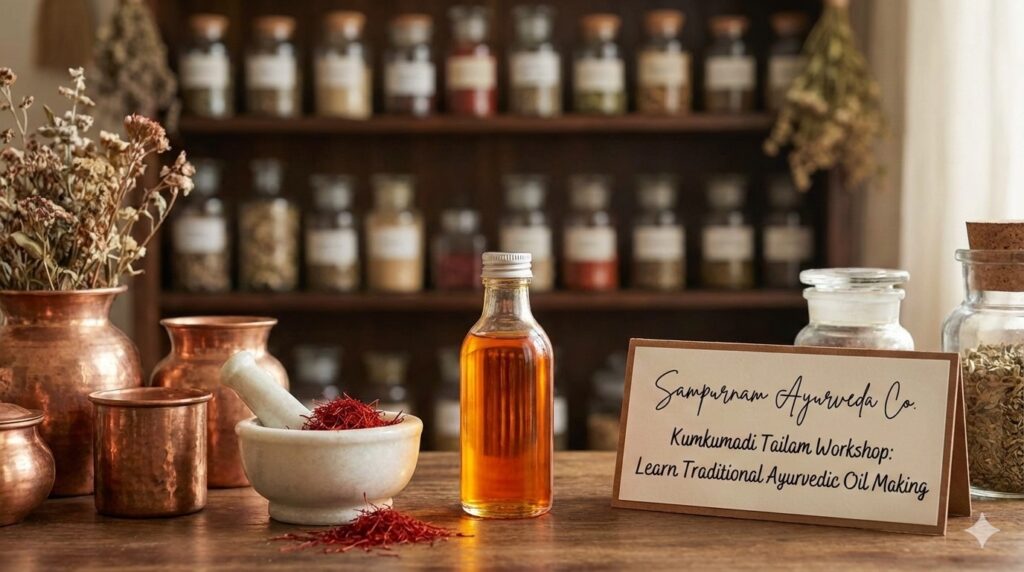
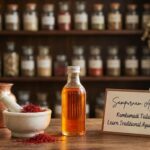
Kumkumadi Tailam Workshop: Learn Traditional Ayurvedic Oil Making
February 9, 2026
Introduction: Why A Neelibhringadi Tailam Online Workshop Matters For BAMS Doctors And Vaidyas
Formulation preparation is not just a clinical skill—it can also be an ethical, stable revenue stream. Many BAMS doctors hesitate to prepare and dispense their own Neelibhringadi Tailam due to concerns about compliance, quality, and standardization, so they send patients to outside brands and lose both control and income.
nThis quiet pattern repeats across practices. The formulation works beautifully, but the bottle carries someone else’s label. Concerns about GMP standards, documentation gaps, and medico-legal questions hold practitioners back. As a result, the doctor:
- Loses control over ingredients and processing
- Loses influence over the full hair-care protocol
- Loses a tangible revenue stream
The Neelibhringadi Tailam Online Workshop was designed to change this. It teaches authentic Kerala-style Snehapaaka Vidhi in a format that busy clinicians and BAMS graduates can implement. The curriculum covers:
- Classical text-based preparation
- Small-batch production SOPs
- Basic labeling and compliance documentation
- Clinical application protocols
- Patient education and follow-up frameworks
By the end, participants can confidently prepare their own Neelibhringadi Tailam, document the process, prescribe with clarity, and offer it as a signature service in their practice. For many, this marks the transition from prescriber to practitioner with a well-grounded product offering.
“One deeply understood formulation builds more trust than a shelf full of outsourced products.”
What Is The Neelibhringadi Tailam Online Workshop By Sampurnam Ayurveda Company?
The Neelibhringadi Tailam Online Workshop by Sampurnam Ayurveda Company is a focused training built around one powerful idea: a single classical formulation, if understood fully, can become a clinical tool, a product, and even a small practice niche. Here, that formulation is Neelibhringadi Tailam, taught through traditional Snehapaaka Vidhi and framed for real-world use.
This is not a casual hair-care webinar. The workshop dives into:
- Taila kalpana principles
- Textual references and classical context
- Stepwise Snehapaaka
- Clinical indications and limitations
- Business basics for clinic-scale work
Participants learn how to move from reading about Neelibhringadi Tailam in books to actually formulating, documenting, and offering it as part of structured protocols. It brings together classical Ayurveda and modern trichology so that explanations to patients can be both rooted and relatable.
Within Sampurnam Ayurveda’s wider curriculum, this workshop sits inside a focused formulation pathway. Alongside trainings in Kumkumadi Tailam, Shatdhauta Ghrita, and other cosmetic and therapeutic preparations, it supports those who search for an authentic ayurvedic cosmetic manufacturing workshop or practical ayurvedic courses after BAMS. For many doctors, it becomes the first safe, guided entry into cosmetic and cosmeceutical formulation.
Faculty strength is another key factor. Formulation and classical nuances are led by Dr. Shreya Patil (MD Rasashastra and Bhaishajyakalpana), who has hands-on experience in Ayurvedic product development. Practice-building and business framing are supported by Dr. Abhijit Patil, who focuses on sustainable models for Ayurvedic entrepreneurs. The entire workshop is delivered online with live classes plus recordings, and registration is open across India and abroad, with smooth payment options like RazorPay and PayPal.
The primary audience includes:
- Ayurvedic doctors wanting to bring Neelibhringadi in-house
- BAMS students and fresh graduates
- Traditional Vaidyas
- Clinic owners exploring product lines
Anyone who wants to stop depending only on outside brands and start building a controlled, authentic Neelibhringadi offering will find this workshop directly relevant.
Classical Ayurvedic Foundations Of Neelibhringadi Tailam For Practitioners
Neelibhringadi Tailam stands in classical practice as a murdhni taila focused on the head and hair, with (PDF) Review on Nilibhringadi documenting its effectiveness as a Keshya medication in traditional texts. In Kerala traditions, it is used for khalitya, palitya, and darunaka, along with heat-related scalp complaints, eye burning, irritability, and disturbed sleep. The workshop revisits these roots so that practitioners see Neelibhringadi not as a cosmetic but as a therapeutic taila kalpana with clear indications and boundaries.
From a dosha and dhatu view, Neelibhringadi Tailam mainly calms aggravated pitta and rakta in the scalp, while also supporting vata at the level of hair roots. Chronic hair complaints often relate to rasa, rakta, asthi, and majja dhatu; the workshop connects these concepts with observable patterns such as:
- Thinning and gradual hair loss
- Early graying
- Scalp inflammation and burning
Participants revisit these ideas not as exam theory but as tools to explain and design protocols.
Key ingredients are explored in depth:
- Neeli supports hair pigmentation and cooling of the scalp.
- Bhringaraja works as a classic keshya rasayana for follicle strength.
- Amla contributes rasayana effect and pitta balance.
- Herbs like Yashtimadhu and other cooling dravya soothe reactive scalp conditions.
- Coconut oil usually forms the gentle, cooling base, though regional and prakriti-based variations are discussed.
The Snehapaaka process is shown as the stage where these herbs change from individual powders or juices into a unified medicated oil.
A strong feature of the workshop is bridge-building between classical and modern language, supported by A Comprehensive Review on the efficacy of Neelibhringadi hair oil in modern hair care contexts. Terms like khalitya and palitya are matched with androgenetic alopecia, telogen effluvium, and premature graying. Darunaka is connected with dry or oily dandruff and seborrheic dermatitis-like pictures. This way, practitioners learn to move comfortably between sutra-style explanations and the expectations of an informed, urban patient who wants both tradition and some scientific sense.
For BAMS doctors and Vaidyas, this grounding has a direct payoff. When they can clearly explain why Neelibhringadi Tailam is appropriate in a given case, they build better compliance and respect. The workshop uses this foundation as the base layer for all later segments on Snehapaaka, protocols, and business.
As Acharya Charaka emphasizes, “Yukti is the physician’s tool” — the right reasoning behind every prescription.
Inside The Snehapaaka Vidhi: Learning Authentic Neelibhringadi Tailam Preparation Step-By-Step
The heart of the Neelibhringadi Tailam Online Workshop is practical Snehapaaka Vidhi. Instead of giving a rough recipe, Sampurnam Ayurveda walks participants through each decision point, from herbs to heat. Doctors learn not only how to “follow” a method but also how to observe and record what happens in the vessel, which is essential for consistent batches.
Stepwise Traditional Preparation As Taught In The Workshop
The process starts with raw material selection and authentication, following comprehensive physicochemical characterization protocols detailed in A Traditional Ayurvedic Oil study that examines quality standards for hair growth formulations. Participants see:
- How to recognize genuine Neeli and Bhringaraja
- How seasonal variations may affect juice yield
- Why basic pharmacognostic sense matters
The faculty explains simple quality checks and the role of lab reports, so practitioners can start asking better questions to suppliers and insist on defined standards.
Next comes preparation of kalka and drava dravya. The workshop shows:
- How finely the herbs should be ground
- What the ideal kalka texture feels like
- How to prepare swarasa, kwatha, or ksheera for the chosen Neelibhringadi variant
These steps are demonstrated visually, so participants can recognize correct consistency rather than rely only on text descriptions.
Classical ratios guide the Snehapaaka itself, often around a sneha:kalka:drava proportion such as 1:1:4, with discussion of acceptable adjustments for scalp-specific oils. Doctors learn the signs of Mridu, Madhyama, and Khara paka, and why Madhyama paka is usually ideal here. Attention is given to practical markers like:
- Change in aroma
- Froth behavior
- How the kalka rolls and separates when tested between fingers
The final stage covers filtration, cooling, and packaging. Participants see how warm filtration through cloth reduces sediment, how to avoid moisture carry-over, and why direct sunlight or high heat at this stage harms quality. The workshop suggests clinic-friendly packaging options and explains how to label small batches clearly for in-house distribution. By the end of this segment, doctors know what a correctly cooked and filtered Neelibhringadi Tailam should look, smell, and feel like.
Small-Batch, Clinic-Scale, And Foundation For GMP Thinking
A key aim is to shift practitioners from a casual “home remedy” mindset to a disciplined clinic-batch mindset. The workshop guides them in setting up repeatable small-batch SOPs for volumes such as 2–5 liters. They learn to record:
- Herb weights and oil volumes
- Reduction endpoints
- Temperature behavior
- Total Snehapaaka time for each batch
These records are not only for memory. They become the foundation for future GMP-oriented thinking. When a doctor later wants to move to a contract manufacturer or their own licensed unit, these notes help in communicating process expectations and product profile. Sampurnam Ayurveda emphasizes that this is text-based and standardized methodology, far removed from random trial-and-error.
Participants also see how even simple controls, such as checking herb dryness and keeping consistent reduction ratios, improve stability and patient acceptance. This balanced approach gives confidence to start clinic-scale work without the pressure of immediately becoming a full factory.
Avoiding Common Preparation Mistakes
Practical teaching includes clear warnings about common mistakes:
- Overheating during Snehapaaka can create a burnt smell, dark color, and loss of subtle herbal qualities. The workshop points out the visual and olfactory signs that help doctors stop heating at the right stage.
- Under-cooked oil is another frequent issue. If moisture remains trapped, the taila may turn rancid faster, grow microbes, or show odd behavior in storage. Participants learn to read moisture cues, check for lingering froth, and test kalka properly, so this risk goes down.
- Poor filtration is addressed, since gritty residue can lead to complaints and reduced trust.
Herb variability is discussed openly. The faculty shares simple minimum checks that a BAMS doctor can realistically do in practice, including:
- Visual inspection and smell
- Basic handling tests
- Written records of supplier and batch
Even these small steps can significantly improve reliability and confidence.
Clinical Application Protocols: From Hair Diagnosis To Neelibhringadi-Centered Treatment Plans
Knowing how to prepare Neelibhringadi Tailam is only half the story. The workshop spends equal time on how to use it in real patients. Rather than “apply twice a week” type advice, participants learn how to assess, decide, and design full protocols where Neelibhringadi sits in the right place alongside internal medicines and procedures.
This approach respects both classical and modern perspectives. Practitioners learn to read the scalp through a dosha–dhatu lens and also through key trichology parameters. They discuss patterns like:
- Androgenetic hair loss
- Telogen effluvium
- Postpartum shedding
- Chronic dandruff
and learn where Neelibhringadi fits strongly, where it needs support, and where it is not the main answer.
Assessing Hair And Scalp In Ayurvedic And Modern Terms
The training revisits prakriti and vikriti assessment with a special focus on scalp and hair. Participants practice distinguishing:
- Pitta–rakta patterns with burning, redness, and early graying
- Vata-dominant dryness and brittleness
- Kapha-related heaviness or clogging of follicles
They learn to include agni status, rasa–rakta quality, menstrual patterns, stress, and sleep quality in every hair consultation.
Modern assessment is brought in without overshadowing Ayurveda. Doctors see how to note:
- Pattern versus diffuse hair loss
- Early baldness trends
- Postpartum telogen effluvium
- Signs of seborrhea or psoriasis-like plaques
They also learn to record current allopathic medicines that may influence hair, such as retinoids or beta-blockers. The workshop provides sample intake forms and case templates that blend these perspectives.
By combining both lenses, practitioners get a fuller picture. They are then better placed to decide whether Neelibhringadi Tailam should be central, supportive, or minimal in the plan. This structured assessment turns a simple “hair oil prescription” into a well-reasoned clinical protocol.
Indications, Contraindications, And Individualized Prescriptions
Participants are guided to use Neelibhringadi Tailam where it shines rather than everywhere. Strong indications include:
- Scalp heat, burning, and redness
- Pitta-type dandruff
- Early graying with clear pitta aggravation
- Hair fall linked to emotional stress or sun exposure with disturbed sleep
In such cases, Neelibhringadi often becomes the main external medicine, especially when paired with internal keshya and pitta–rakta balancing support.
Relative cautions are also discussed in detail. For example:
- Patients with chronic sinusitis or migraine may not tolerate heavy nocturnal oiling on the head.
- Very vata–kapha individuals in cold climates might need adjustments in base oil or frequency.
- Those with previous reactions to coconut oil or any included herb must be tested carefully with patch application.
The workshop shows how to turn these ideas into clear prescriptions, including:
- How much oil to use
- How often and at what time of day
- How long to keep it on before washing
Doctors also learn how to combine Neelibhringadi with other external therapies, like medicated shampoos or decoction rinses, based on the pattern in front of them.
Integrating Neelibhringadi Tailam With Panchakarma, Bahya Snehana, And Internal Medicines
Real hair care in Ayurveda is rarely only about what touches the scalp. The workshop lays out how Neelibhringadi Tailam fits into bahya snehana procedures such as shiro abhyanga and shiro pichu. Participants see session plans where head massage, targeted oil retention, and gentle relaxation methods are arranged for better outcomes in heat, stress, and insomnia-linked hair loss.
Internal support is covered just as carefully. Faculty discuss:
- When to add keshya rasayana like Bhringaraja-based preparations or Amla formulas
- When to include rakta–pittahara medicines for combined skin and hair issues
- How basic gut-focused work through deepana–pachana and, where indicated, mild cleansing can support results
Through case-based segments, doctors compare approaches for androgenetic hair thinning, postpartum hair fall, and seborrheic scalp with itching. Each case links assessment, Neelibhringadi use, internal medication selection, and follow-up planning over three to six months. This repeated pattern trains participants to think in complete protocols instead of isolated prescriptions.
From Formulator To Ayurvedic Entrepreneur: Turning Neelibhringadi Tailam Into A Clinic Brand
A powerful feature of the Neelibhringadi Tailam Online Workshop is its entrepreneurial lens. Once a doctor can prepare, standardize, and clinically use Neelibhringadi Tailam, the next natural question is how to present it as a professional, revenue-generating service and product. Sampurnam Ayurveda addresses this directly, so participants do not feel lost when thinking about branding, pricing, or packaging.
The workshop explains how Neelibhringadi Tailam can sit at the center of a hair and scalp offering rather than be a side product. Participants see how in-house preparation, careful documentation, and clear communication can support a recognized “clinic brand,” even before full-scale manufacturing licenses are pursued. This mindset shift is especially helpful for those treating the workshop as a focused cosmetic manufacturing workshop for BAMS doctors.
Positioning Neelibhringadi Tailam As A Signature Service And Product
Doctors learn to shape Neelibhringadi-based services that reflect their clinical strengths. For example, a “Neelibhringadi Scalp Rejuvenation Session” can combine:
- Detailed assessment
- Head massage with Neelibhringadi Tailam
- Targeted oil retention with shiro pichu or short shirodhara-style flow
- Brief counseling on diet, stress, and hair routines
Such a session has both therapeutic depth and clear structure, making it easier to explain and price.
Take-home bottles of Neelibhringadi Tailam prepared in-house become a natural extension of these services. The workshop suggests clear usage instructions and printed guides, so patients know exactly how to apply the oil between sessions. When patients hear that the oil is a classical Neelibhringadi prepared by their own Vaidya, trust often deepens, especially compared with generic over-the-counter brands.
Text-based authenticity is positioned as a strong advantage. Sampurnam Ayurveda encourages participants to highlight that their Neelibhringadi follows classical references and documented Snehapaaka Vidhi learned under expert guidance. This type of honesty matches the growing demand for transparent Ayurveda and can influence word-of-mouth referrals.
“People don’t just buy products; they buy the story and integrity behind them.”
Basic Compliance, Labeling, And Documentation For Small-Scale Practice
Regulation can feel intimidating, so the workshop breaks it down into practical layers. First, it distinguishes between in-clinic dispensing for one’s own patients and full-fledged external commercial marketing. For the former, simple but clear documentation goes a long way in showing responsible practice.
Participants are guided on what to write on labels for in-house batches, such as:
- Name of the preparation (Neelibhringadi Tailam)
- List of key ingredients and base oil
- Preparation date and batch identification
- Storage advice and usage directions
- Essential cautions and duration of use
They also learn to maintain a basic logbook where each batch is recorded with quantities and notes about any variation.
For those who later wish to enter licensed manufacturing, Sampurnam Ayurveda outlines the path and encourages budgeting for legal and regulatory experts. The aim is not to train doctors as lawyers, but to give them enough clarity so they can speak well with consultants and avoid unsafe shortcuts. Ethical practice and long-term thinking are stressed throughout.
Patient Education, Follow-Up, And Building Trust
The workshop also recognizes that even the best oil fails if patients do not use it correctly or hold unrealistic hopes. So there is special attention on counseling skills. Doctors receive example scripts and talking points for explaining what Neelibhringadi Tailam can and cannot do in cases like long-standing baldness or scarring alopecias.
Practical instructions are covered in simple language, including:
- How much oil to use per application
- How often to apply and at what time of day
- How to massage and how long to keep before washing
- Correct washing techniques to avoid leftover residue
Precautions for sensitive scalps and sinus-prone individuals are also part of this teaching.
Finally, participants see how structured follow-up improves both outcomes and patient satisfaction. The workshop shares ideas for:
- 6–8 weekly review patterns
- Simple photo documentation with consent
- Symptom and satisfaction tracking
When patients see honest communication and steady results, they tend to trust the doctor more, recommend them to others, and stay with their Neelibhringadi-based protocols longer.
Why This Neelibhringadi Tailam Online Workshop Is An Ideal Ayurvedic Course After BAMS
Many recent BAMS graduates feel a gap between what they studied and what their clinic or job actually needs. They know taila kalpana definitions, but they have never stood over an oil vessel, corrected a batch, or designed a real protocol. The Neelibhringadi Tailam Online Workshop is shaped to close this gap in a focused, practical way.
It directly addresses the missing link between theory, practice, and business. Standard Ayurveda curricula often pay limited attention to small-batch manufacturing, basic regulatory logic, or how to turn one good formulation into a practice asset. By centering on a familiar yet deep topic like Neelibhringadi Tailam, this workshop makes those themes concrete and easier to absorb.
Learning is hands-on and guided. Participants interact with master formulators like Dr. Shreya Patil, who shares lived experience rather than only textbook lines. They can ask questions about:
- Raw material sourcing
- Specific steps in Snehapaaka
- Mistakes in earlier attempts
- Tricky patient patterns and non-responders
On the business side, they can clarify doubts about pricing, scaling, and working alongside contract manufacturers in the future.
For a fresh graduate or young practitioner, the outcomes are very tangible. They walk away with:
- At least one reliable, text-based Neelibhringadi recipe
- A tested preparation method and SOP
- A clear protocol they can offer in practice
- Confidence to start a focused hair-care segment within their clinic
They also see a pathway for expanding into a wider Ayurvedic cosmetic and hair-care line later, without giving up their clinical identity.
Viewed in this light, the workshop fits neatly into the idea of ayurvedic courses after BAMS that actually change day-to-day work. Instead of another abstract certificate, it delivers a precise skill that can support both clinical depth and early-stage entrepreneurship. Sampurnam Ayurveda positions Neelibhringadi as the starting point in a longer arc of ethical, practitioner-led product development.
Conclusion
The Neelibhringadi Tailam Online Workshop from Sampurnam Ayurveda Company offers a clear shift for Ayurvedic doctors and BAMS graduates who are tired of depending only on outside brands. By combining classical Snehapaaka Vidhi, solid clinical reasoning, and basic business sense, it helps practitioners move from hesitation to confident preparation and prescription of their own Neelibhringadi Tailam.
The training rests on three strong pillars:
- Authentic formulation that respects taila kalpana principles and shows every step of Neelibhringadi preparation in clinic-scale detail.
- Structured clinical protocols that connect dosha–dhatu analysis with modern hair science and clearly define when and how Neelibhringadi should be used.
- Grounded business and compliance perspective that makes small-batch production, labeling, and patient communication feel manageable instead of frightening.
Sampurnam Ayurveda brings together expert formulators, practice mentors, and a like-minded community so that participants are not alone while trying to build this part of their work. For those looking for meaningful ayurvedic courses after BAMS, or for senior Vaidyas wanting to formalize their oil preparations, this workshop offers a practical next step.
With the upcoming batch scheduled for June 14, 2025 and an online format that supports doctors across India and abroad, joining is straightforward. Registrations are simple through platforms such as RazorPay and PayPal. For any practitioner who wants Neelibhringadi Tailam to move from someone else’s label into their own carefully prepared clinic bottle, this is a timely and strategic investment in their Ayurvedic practice.
FAQs
Question: Who Should Join The Neelibhringadi Tailam Online Workshop?
The workshop is designed for BAMS doctors, MD Ayurveda practitioners, traditional Vaidyas, final-year BAMS students, and Ayurvedic clinic owners. It suits anyone who already uses or wants to use Neelibhringadi Tailam but feels limited by dependence on external brands or by fear of regulations and quality control.
It is especially helpful for practitioners who plan to:
- Prepare their own Neelibhringadi Tailam for in-clinic use
- Build a signature scalp therapy service
- Start shaping a dedicated hair-care line rooted in classical texts
The teaching assumes basic Ayurvedic training, so participants can directly apply what they learn.
Question: Is This Workshop Suitable As An Ayurvedic Course After BAMS?
Yes, it fits very well as a focused ayurvedic course after BAMS. The content takes core taila kalpana concepts from textbooks and turns them into live steps, clinical algorithms, and basic business actions that a young practitioner can understand and implement.
Recent graduates often lack safe spaces to practice formulation under guidance. This workshop fills that gap with:
- Structured demonstrations
- Case discussions
- Templates for documentation and protocols
These help them gain confidence in both preparation and prescription of Neelibhringadi Tailam early in their careers.
Question: Will I Be Able To Manufacture And Sell My Own Neelibhringadi Tailam After The Workshop?
After completing the workshop, participants will have a clear SOP for small-batch, clinic-level preparation of Neelibhringadi Tailam and an understanding of how to document each batch for professional use. They will know what to write on labels for in-house dispensing and how to explain the product to patients responsibly.
For larger-scale commercial manufacturing and wide retail distribution, formal licensing and regulatory steps are still required. The workshop explains these requirements and the general path forward, but it does not replace the need for proper AYUSH permissions or legal consultation. Instead, it prepares doctors to speak confidently with consultants and manufacturers when they are ready to grow.
Question: How Is This Different From A Generic Ayurvedic Cosmetic Manufacturing Workshop?
This workshop focuses deeply on one classical formulation, Neelibhringadi Tailam, and the Snehapaaka Vidhi that brings it to life. It does not skim across many products in a superficial way. Instead, it shows all stages around a single oil, from textual reasoning and preparation to clinical use and business framing.
Along with that, there is a strong emphasis on protocol design, evidence-aware practice, and patient education, which many generic workshops overlook. The teaching is created for Ayurvedic doctors and clinic-based entrepreneurs, so discussions on pricing, compliance, and service design stay grounded in the realities of an Ayurvedic practice rather than in generic cosmetic industry trends.