
Business Opportunities for Ayurveda Doctors
December 14, 2025
Neelibhringadi Tailam Mastery: Revenue Boost for BAMS Doctors
February 13, 2026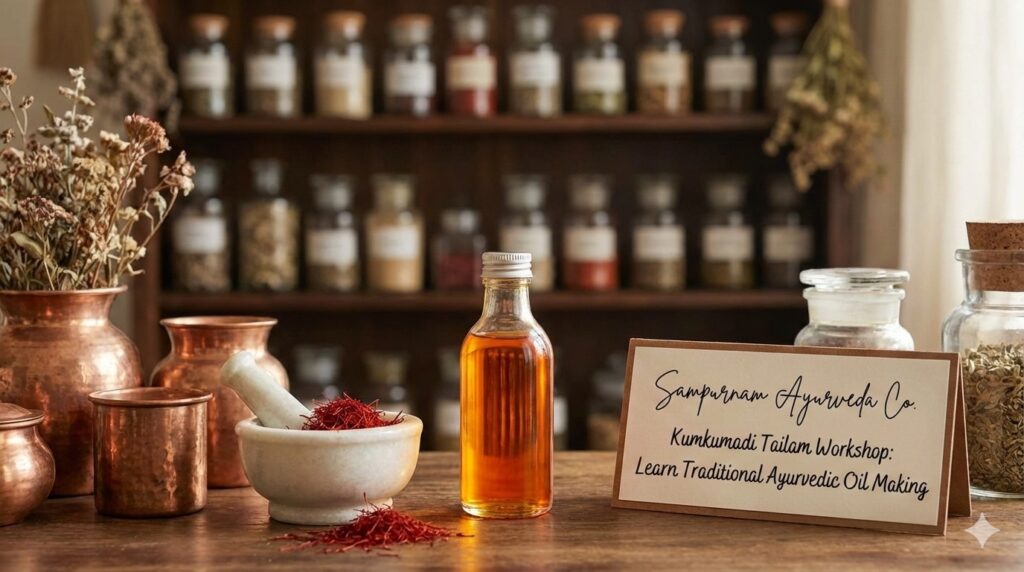
Kumkumadi Tailam Workshop: Learn Traditional Ayurvedic Oil Making
Introduction
A BAMS doctor spends five and a half years with Samhita, Dravyaguna, Rasashastra and endless exams. Yet many still sit in a quiet clinic, waiting for patients and worrying about rent. At the same time, a non‑doctor with a pretty label and a social media page is selling Kumkumadi oil by the thousands and posting screenshots of monthly sales.
This contrast hurts because every doctor knows the texts behind Kumkumadi Tailam, the Varnya, Kantivardhaka and Twachya verses by heart. Still, most have never done an authentic Taila Kalpana from start to finish. Practical Bhaishajya Kalpana often gets rushed in college, and nobody really shows how to move from theory to a marketable, high quality product. The gap is not in knowledge of shloka; it is in hands-on preparation, sourcing, quality checks and business thinking.
As many classical teachers remind their students, “Knowledge that never enters the mortar, pestle and fire stays half-finished.”
Our kumkumadi tailam workshop at Sampurnam Ayurveda Company was created exactly for this gap. We take the classical text, the science and the real market demand and put them together in a clear, stepwise way. In this training we focus on how to make Kumkumadi oil with proper Taila Paka Vidhi, authentic raw materials and practical guidance on pricing, packaging and AYUSH rules. By the end, participants see that authentic Ayurvedic oil making can support both clinical results and a strong product line. Reading this article gives a clear picture of what we cover, how we teach, and how this one skill can change how an Ayurvedic practice grows.
Key Takeaways
- We guide participants through the full classical process of Taila Kalpana with live fire, real utensils and complete Taila Paka Vidhi practice so the method becomes second nature. This builds confidence that goes far beyond textbook steps and shows exactly where most commercial products compromise.
- We focus on ingredient identification, from Kashmiri saffron threads to Mysore sandalwood chips and cold pressed sesame oil. Participants learn simple tests they can do in their own clinic and receive a curated list of reliable suppliers. This keeps every future batch close to classical standards.
- We explain Paka Siddhi Lakshanas and other subtle signs that decide whether a batch is undercooked, perfect or spoiled. Through repeated observation and comparison, participants train their eyes, nose and hands. This sensory skill is one of the strongest outcomes of the kumkumadi tailam workshop.
- We teach customization, cost calculation and quality checks so that Kumkumadi Tailam can serve real patients and also sit confidently on a clinic shelf. This includes options for Aavartita batches, dosha specific tweaks and integration with other skincare protocols.
- We support doctors beyond the classroom with templates, regulatory guidance and mentoring on branding. This helps turn one successful batch into a repeatable line of authentic products, including scope for other authentic Siddha tailam preparation styles in the future.
The Market Reality: Why BAMS Doctors Struggle While Non-Practitioners Profit
When we speak with BAMS graduates, a common story appears. The degree is strong on Samhita, Siddhanta and Dravyaguna, but very light on product development, sourcing, costing and branding. Most doctors know the shloka for Kumkumadi Tailam but hesitate to actually prepare it, bottle it and put their own name on the label.
At the same time, the Ayurvedic skincare market is booming. Kumkumadi Tailam sits at the center of this boom. A 10 ml bottle easily sells between ₹500 and ₹3,000, often prepared with shortcuts, fragrance additives and minimal adherence to classical Taila Paka Vidhi. Many sellers are not doctors, yet they invest in packaging, photography and online marketing, and patients buy from them.
This creates a strange situation:
- The people who understand Vyanga, Yauvanapidika, Bhrajaka Pitta and Twak Vikara in depth are not the ones earning from these powerful formulations.
- Doctors miss steady product income, while non‑practitioners earn well from the same texts doctors studied.
- Patients lose too, because they rarely get a truly authentic oil made under medical supervision.
One of our workshop participants once said, “I realised my clinic did not need more prescriptions, it needed at least one medicine that carried my own name and responsibility.”
Our mission at Sampurnam Ayurveda Company is to change this picture. Through our kumkumadi tailam workshop, we help Ayurvedic doctors claim their natural space in this market. We focus on practical skills in Taila Kalpana, raw material checks, batch records, pricing and positioning. With even one consistent product like Kumkumadi Tailam, a clinic gains an extra income stream and deeper trust, because patients prefer a bottle made and explained by their own physician.
Understanding Kumkumadi Tailam: Classical Foundations And Modern Relevance
Kumkumadi Tailam is not a modern cosmetic idea. It comes from solid classical roots, especially Bhaishajya Ratnavali in the Kshudra Roga Chikitsa chapter, with supporting ideas from texts like Ashtanga Hridayam. The very name comes from Kumkuma, or saffron, which is the central Varnya herb that gives the oil its glow-giving power.
The formulation is classically advised for Vyanga and Nilika type hyperpigmentation, Yauvanapidika related marks, general Varna Vikara and to bring a Kanchana Sannibha or golden tone to the face. It mainly calms Pitta and Vata at the level of Bhrajaka Pitta and the superficial Dhatus, which is why it works so well for dull, dry, inflamed or spotty skin. At the same time, its Tridosha balancing nature makes it gentle when used correctly.
From a formulation view, Kumkumadi Tailam is a rich polyherbal oil. It brings together more than twenty herbs and substances in different roles as Kashaya Dravya, Kalka Dravya and Sneha Dravya. Ingredients like Laksha, Manjistha, Chandana, Yashtimadhu, Padmaka and others work together in a sesame oil and milk base to give both external and deeper effects. The method of cooking with Kashaya, Kalka and Go‑Dugdha is as important as the herbs themselves.
Modern research now supports what the acharyas taught. Saffron shows strong antioxidant and skin-supporting activity, licorice contains glabridin that slows excess melanin production and Manjistha supports healthy blood and microcirculation. These actions match the classical Varnya, Rakta Prasadana and Shothahara descriptions. This is one reason Kumkumadi Tailam has become a hero product in natural skincare lines across many regions.
In our kumkumadi tailam workshop, we respect both sides. We read and discuss the verses, but we also connect them with modern dermatology and cosmeceutical science. This helps doctors explain the oil confidently to patients who ask for scientific reasoning along with Sanskrit terms.
Deep Dive Into The Ingredient Pharmacognosy: Sourcing Authentic Raw Materials
Every batch of Kumkumadi Tailam stands on the quality of its herbs and base oils. Even a perfect Taila Paka Vidhi cannot fix weak, old or adulterated raw materials. That is why a full module in our kumkumadi tailam workshop is dedicated to pharmacognosy and sourcing.
- We spend extra time on saffron, because it is costly and often adulterated. Participants handle threads from different sources, observe color and aroma, and see how pure saffron releases a slow golden hue in warm water while keeping its red strand intact. We discuss Kashmiri and Iranian grades, pricing patterns and simple ways to avoid dyed corn silk or mixed petals.
- Sandalwood is another sensitive raw material. We bring real Santalum album heartwood and common substitutes so participants can compare texture, lasting fragrance and color. We also speak about legal restrictions, government auctions and how to buy chips or powder only from lawful, traceable sources. This keeps the oil both ethical and potent.
- Herbs like Manjistha, Laksha and Yashtimadhu need correct identification as well. We show how true Manjistha reveals a red inner core when scraped, how purified Laksha appears after Shodhana, and how good licorice root looks and tastes. These small checks protect the final oil from hidden weakness.
- Sesame oil, or Tila Taila, forms the foundation of authentic Kumkumadi Tailam. We teach how to choose cold pressed, unrefined oil with correct smell, color and viscosity. Participants learn about Murchana steps that clean the oil and support stability before Sneha Kalpana starts. A strong base oil supports both activity and shelf life.
- Beyond identification, we discuss building long term supplier ties. Participants see sample certificates of analysis, basic lab tests and HPTLC profiles. We keep the methods practical so even a small clinic can start with macroscopic checks and organoleptic testing. Our team also shares a starter list of trusted vendors that we use in Sampurnam Ayurveda Company programs.
One principle we repeat often is, “If the herb in your hand is weak, no mantra and no marketing can rescue the medicine.”
Mastering The Classical Preparation: Taila Paka Vidhi Step-By-Step
Once the herbs and base oils are right, the heart of authentic preparation begins. Taila Paka Vidhi is the art and science of heating oil with Kashaya and Kalka until the Sneha carries both water soluble and fat soluble actives. In our kumkumadi tailam workshop, participants stand at the vessel, stir, observe and cook the oil themselves under guidance.
Stage 1 – Preparation Of Kashaya (Herbal Decoction)
We begin with the Kashaya Dravyas named in the classical recipe, cleaned and crushed to coarse powder. These are mixed with sixteen times water in a thick bottom vessel, usually iron or heavy steel, to support slow, even heat. The mixture cooks on Mandagni, a low steady flame that allows gentle extraction without burning delicate components.
Participants learn to watch the reduction carefully rather than guessing. We show easy ways to mark the starting level and to confirm one fourth volume in a repeatable way. Once reduced, the decoction is filtered through a clean, tight cloth so that no particles remain. We also point out common mistakes such as high flame, poor stirring or incomplete filtration, which weaken the final Tailam.
Stage 2 – Preparation Of Kalka (Herbal Paste)
The Kalka Dravyas are mostly aromatic, fine herbs that carry many fat loving actives. We grind them with a small amount of liquid to a smooth paste with no visible fibers or lumps, through stone grinder or modern equipment. During the workshop, everyone checks the paste between fingers to feel a chutney like, even texture that mixes well into the oil. We keep to the classical rule that the Kalka quantity is roughly one fourth of the base oil so the mixture stays balanced and does not become heavy sludge.
Stage 3 – The Critical Taila Paka Process
In the main cooking stage, we combine Tila Taila, the prepared Kashaya, the Kalka and fresh cow milk in the classical ratio. The vessel goes again on Mandagni, and from this point constant attention is needed. High heat can scorch the paste at the bottom or break sensitive phytochemicals, so we train participants to aim for steady, low bubbles and slow evaporation.
Throughout this period, which often runs for four to six hours, the batch must be stirred again and again so that the Kalka never sticks or burns. We teach how to read the change in sound, from watery bubbling to thicker, quieter boiling, and how color shifts toward a deeper tone as actives move into the oil. By cooking shoulder to shoulder, doctors gain a body sense of timing and texture that a simple recipe sheet can never offer.
Stage 4 – Identifying Paka Siddhi Lakshanas (Signs Of Perfect Preparation)
The most important decision in Taila Paka Vidhi is when to stop the heat. We practice the traditional Paka Siddhi Lakshana tests that acharyas described. Participants observe how the foam behavior changes, how a pinch of Kalka behaves on a small flame and how it rolls smoothly into a wick between the fingers when moisture has gone.
We also smell and see the oil together to understand the right Gandha and Varna that come with Madhyama Paka, the ideal stage for Kumkumadi Tailam. By repeating these tests on actual batches, not only on diagrams, the signs become very clear. This is one of the strongest benefits of doing a live kumkumadi tailam workshop instead of only reading procedures.
Advanced Formulation Techniques: Customization And Potentization
Once doctors are comfortable with the classical method, many wish to go deeper. Advanced formulation lets a clinic offer special Kumkumadi variants for specific patients or premium lines while still respecting Ayurveda.
We introduce the process of Aavartana, where a finished batch of Kumkumadi Tailam becomes the base oil for another round of Taila Paka. With each repeat, the concentration of herbal actives rises. In the workshop we show how to plan and cost smaller multi Aavartita batches that can be reserved for severe hyperpigmentation, old scars or advanced ageing signs.
For dosha based customization, we explain how to adjust gently without disturbing the core formula:
- A drier, Vata heavy face may do better when slightly more milk and a few extra Vatahara herbs are woven into the process.
- A sensitive, red Pitta face can benefit from increased Chandana, Ushira and other cooling herbs.
- For Kapha heavy, oily skin, more Lekhana herbs like Lodhra can be added in a measured way.
We also touch on modern supportive ingredients. Natural vitamin E can help slow oxidation and support skin repair. Carefully chosen essential oils or CO₂ extracts can raise the sensory feel or add targeted effects without drowning the classical character. Alongside all this, we show how to keep detailed batch records so that any successful customized batch can be repeated safely and later presented to regulators if needed.
During the kumkumadi tailam workshop, participants actually prepare at least one small customized variant. This turns theory about higher strength or dosha focus into real bottles they can test in practice.
Quality Control, Standardization, And Regulatory Compliance
For a doctor who wants to sell Kumkumadi Tailam beyond a few patients, quality control and law compliance are non‑negotiable. In our kumkumadi tailam workshop, we break this down into simple, workable steps.
1. Raw material checks. Participants learn how to document macroscopic and microscopic identification, and how to request or read a basic certificate of analysis for herbs and oils. We explain simple phytochemical tests and discuss when to use HPTLC or similar advanced methods to confirm marker compounds like crocin or glabridin. Attention to heavy metals, pesticide residue and microbial load keeps the product safe and ready for export if needed, following established physicochemical screening and shelf life protocols for traditional oils.
2. In process controls. This includes recording starting volumes, reduction levels, temperature ranges and approximate cooking time for every batch. We again stress Kalka tests, pH readings where useful and clean handling to avoid contamination. These records support both consistency and AYUSH inspections.
3. Finished product testing. We go over checks for color, aroma, clarity, viscosity, acid value and peroxide value so that each batch matches a set standard. Participants see examples of chromatographic fingerprints where one batch is compared with a master profile. Stability checks under different conditions help decide shelf life and storage advice printed on the label.
4. AYUSH and licensing. Finally, we walk through the AYUSH framework. We explain when Kumkumadi Tailam counts as a classical medicine and when a modified batch becomes a proprietary one. The workshop covers the broad steps for GMP certification, manufacturing license and the exact label contents required under Rule 161, including external use warnings. We also touch on ethical marketing so that claims match classical texts and avoid banned disease cure promises. Sampurnam Ayurveda Company shares templates and checklists so doctors do not have to start this work from zero.
Good records, clean batches and honest labels are the real branding of a vaidya-owned product.
Building Your Ayurvedic Brand: From Clinic Product To Commercial Success
Once a doctor can prepare and standardize Kumkumadi Tailam, the next step is to bring it into patients’ hands in a structured way. Our kumkumadi tailam workshop includes a clear, practical look at branding and business.
We suggest starting simple. Many participants begin by giving or selling small bottles to their own patients who already trust them. A basic feedback form or follow up call collects real life results, skin changes and user experience. These first few batches become the base for testimonials, minor adjustments and early word of mouth.
We then help participants define what makes their Kumkumadi Tailam stand out. Some choose strict classical adherence with textual reference on the label. Others focus on Aavartita batches for higher strength, or on premium sourcing such as single origin Kashmiri saffron. The medical background itself is a strong point because patients value a doctor formulated oil more than a random online brand.
Packaging plays a big role in perceived value. We discuss:
- Bottle size, glass color and dropper use.
- Label design that reflects both Ayurveda and modern clarity.
- Outer boxes, inserts and basic storage advice that reassure patients.
Pricing is approached through cost of goods, market range and value based thinking so that a 10 ml bottle can sit confidently between ₹800 and ₹2,500 depending on grade and positioning.
For scaling, we outline two clear paths:
- In house preparation in a small pharmacy setup for limited but very controlled batches.
- Partnership with a GMP certified contract manufacturer who follows the doctor’s SOPs.
We also cover offline and online channels, from clinic counters and other practitioners’ clinics to websites, social media and curated marketplaces. Sampurnam Ayurveda Company supports alumni with advice on these steps so they can move at their own speed.
Who Should Attend This Workshop And What To Expect
Our kumkumadi tailam workshop is designed for those who already have a base in Ayurveda and now want to build strong hands-on skills. The group usually includes fresh BAMS graduates, senior practitioners and clinic owners who feel they have not used their pharmaceutical training to its full strength.
- Ayurvedic doctors find the workshop especially helpful when they feel stuck between strong theory and weak income. They already understand Rasa Panchaka, Dhatu and Dosha, so once they see the oil making steps live, everything clicks quickly. Many share that they regain excitement for pharmacy work after years of only prescribing ready products.
- Traditional Vaidyas appreciate the structured, documented approach. They often learned from family lines and enjoy seeing how their traditional methods match or differ from classical verses. The space also allows them to share tips with younger doctors, creating meaningful peer learning.
- Clinic owners and healthcare entrepreneurs use the workshop as a starting point for a wider product line. Kumkumadi Tailam becomes their flagship item, and later they add face cleansers, masks or other oils using the same quality mindset. The two day format gives them enough depth to plan investments with clarity.
Across two intensive days:
- The first day focuses on theory, ingredient handling and planning a batch.
- The second day runs through complete how to make Kumkumadi oil practice from Kashaya to filtration.
Every participant goes home with a bottle of their own oil, a detailed manual, supplier contacts and a certificate from Sampurnam Ayurveda Company. Small batch sizes keep the space interactive and give everybody enough time at the vessel.
Conclusion
Many Ayurvedic doctors quietly feel that their skills are underused. They read the same texts that big brands quote, yet they hesitate to put their own name on a bottle of Kumkumadi Tailam. The gap is not in knowledge; it is in guided practice and confidence around preparation, law and business.
Our kumkumadi tailam workshop is our way of handing that power back to the vaidya. When doctors prepare their own Kumkumadi Tailam with authentic Taila Paka Vidhi, they bring real quality to the market and protect the image of Ayurveda. Patients benefit from cleaner, better oils, and clinics gain a stable, premium product line that supports income without compromising ethics.
At Sampurnam Ayurveda Company we do more than teach a recipe. We stand with our participants from raw material choice to branding and pricing. We connect Shastra with Vyavahara so that a classical idea becomes a living, sustainable part of practice.
If this speaks to long held plans in your mind, this is a good time to act. Join our next kumkumadi tailam workshop, learn authentic oil making with your own hands and let Kumkumadi Tailam become the first strong product under your own Ayurvedic brand.
FAQs
Question 1: I Completed My BAMS Years Ago And Haven’t Practiced Rasashastra Since College. Can I Still Join This Workshop?
Yes, this kumkumadi tailam workshop is made for doctors exactly like that. We start from core ideas and move step by step into practical work, without assuming recent college practice. The live cooking, repeated tests and printed SOPs bring back what was forgotten and add many details that were never shown in classrooms. Many senior practitioners say they feel more confident after two days here than after their full college practicals.
Question 2: How Is This Different From What I Learned In My BAMS Curriculum?
BAMS classes usually give short demonstrations and focus mainly on theory and exam writing. In our workshop, you stand at the vessel, plan the batch, stir, test Paka Siddhi Lakshanas and bottle the oil yourself. We also add topics that colleges rarely cover such as sourcing, quality reports, costing, label rules and basic marketing. That way you do not just know how to make Kumkumadi oil, you also know how to bring it to patients and customers with confidence.
Question 3: I Want To Sell This Product. Will You Teach Me About Licensing And Legal Requirements?
Regulatory questions are an important part of our kumkumadi tailam workshop content. We walk through AYUSH manufacturing licenses, GMP expectations and what counts as classical or proprietary. You see real label examples that follow Rule 161 and learn which claims are allowed and which are risky. We also discuss when to choose in house production and when to work with a contract manufacturer, along with the basic paperwork needed for each path.
Question 4: What Is The Cost Of Ingredients For One Batch, And What Can I Price The Final Product At?
During the workshop we run a sample costing exercise using real market prices for saffron, sandalwood and other key herbs. Depending on grade and source, a 100 ml batch of Kumkumadi Tailam usually needs an ingredient cost in the range you often see in premium clinics. From this base, we show how to calculate a per bottle cost, add fair margins for your time, quality testing and packaging, and then decide a selling price that sits well in the current market. Doctors are often surprised by how healthy the margins can be while still giving full value to patients.
Question 5: Do You Provide Post-Workshop Support If I Face Challenges During Preparation At My Clinic?
Support after the kumkumadi tailam workshop is a key promise from Sampurnam Ayurveda Company. All participants join a private alumni group where they can share photos, batch notes and questions. Our team answers doubts on Paka stages, ingredient issues, storage problems and even branding and pricing. We also host regular online meets where alumni present their experiences and learn from each other. The idea is that you never feel alone when you set up Kumkumadi Tailam or any other authentic Siddha tailam preparation in your own space.